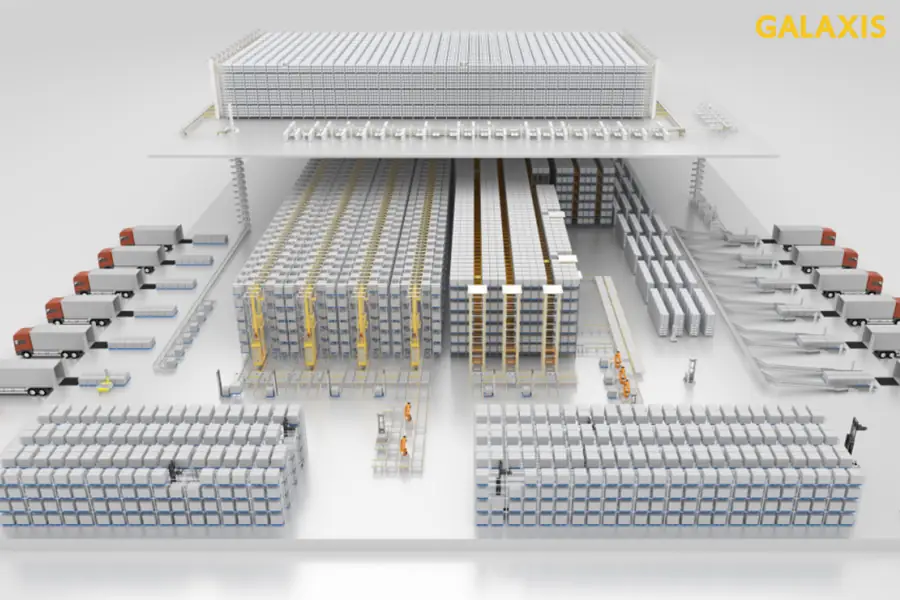
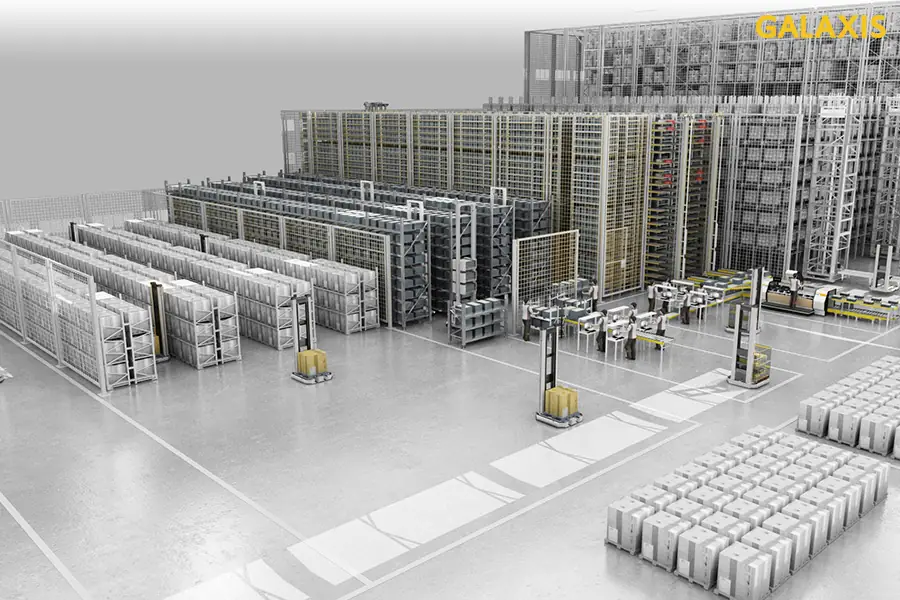
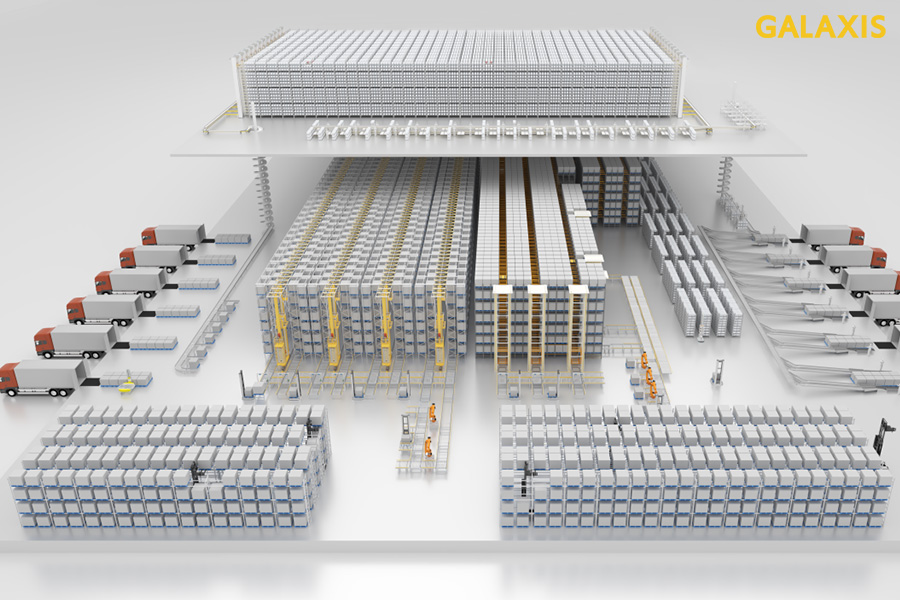
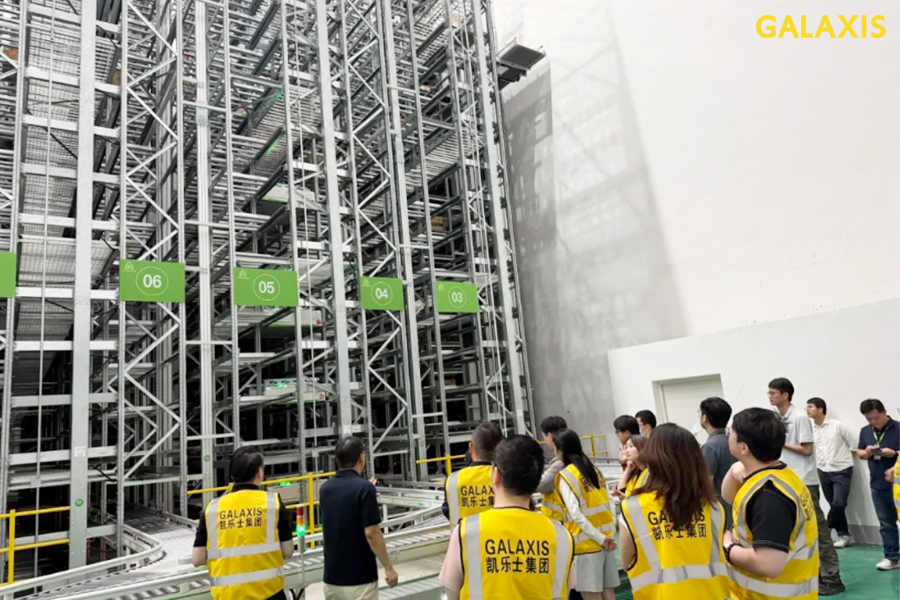
On August 28, GALAXIS officially launched RCS 3.0, the latest generation of its Robot Control System.
Since the introduction of RCS 2.0 in 2021, which enabled mixed-fleet scheduling across multiple robot brands and large-scale robot coordination in three-dimensional environments, intralogistics operations have continued to grow in scale and complexity.
To address these evolving requirements, GALAXIS developed RCS 3.0 around three core principles: scenario-driven design, Digital Twin (DT) as the foundation, and AI as the intelligence engine.
The new platform integrates six core capabilities — planning, simulation, virtual commissioning, control, scheduling, and operations & maintenance — into a unified system. Rather than serving as standalone tools, digital twin and AI technologies are embedded throughout the platform to support the full lifecycle of robotic intralogistics operations.
01 3D Visualization & Digital Twin
RCS 3.0 provides seamless switching between 2D and 3D views, combined with high-fidelity digital twin capabilities.
The platform maps equipment and operating status into an intuitive 3D environment, allowing users to quickly understand robot locations, material movements, and equipment conditions. This makes complex operational data easier to interpret, even for users without specialized technical training.
02 AI-Based Spatial-Temporal Optimization
Conventional scheduling systems often focus primarily on finding the shortest path between an origin and destination. In high-density robot environments, however, shortest-path planning alone may not deliver the best overall system performance.
RCS 3.0 applies AI-based three-dimensional spatial-temporal algorithms that combine spatial conflict avoidance, time-slot reservation, and task sequencing. This enables dynamic coordination across robot fleets and supports smoother traffic flow in high-density, high-throughput operations.
03 Intelligent Task Orchestration
RCS 3.0 manages task allocation, sequencing, scheduling, and dynamic reassignment across robotic operations.
The platform also introduces “Xiao Kai,” an AI voice assistant, enabling natural-language interaction and task creation without relying entirely on an upstream host system. This provides a more accessible path for conventional warehouses looking to introduce intelligent robot control.
Full-process task visualization also allows users to track task status and execution across the workflow.
04 Integrated Simulation
Traditional project implementation often exposes layout, traffic, and process issues only after equipment arrives on site, increasing commissioning time and rework.
RCS 3.0 includes a native simulation engine that supports direct CAD import and AI-assisted fleet generation. Its architecture separates business logic from underlying system code, allowing users to configure virtual tasks, inventory, and simulation scenarios without programming.
With a simplified six-step workflow, different operating scenarios can be tested and refined in a virtual environment before physical deployment, helping reduce implementation risk and on-site trial-and-error.
05 Virtual Commissioning
RCS 3.0 extends digital twin technology into system commissioning.
Its equipment simulation engine creates virtual representations that use the same interfaces, data structures, and control logic as the physical system. This allows interface verification, task-flow testing, and potential issue identification to begin before physical equipment is fully available on site.
By moving part of the commissioning process into a virtual environment, project teams can identify risks earlier and reduce the time required for on-site integration and testing.
06 AI-Assisted Predictive Maintenance
RCS 3.0 combines AI analysis with cloud-based service processes to support more proactive operations and maintenance.
When abnormalities occur, AI can perform an initial diagnosis and recommend possible actions. More complex issues can be automatically routed through service workflows for follow-up and resolution.
Preventive maintenance reminders and spare-parts forecasting further help shift maintenance from reactive troubleshooting toward more proactive lifecycle management.
Independent Software Deployment Expands RCS 3.0 Applications
RCS 3.0 is designed not only as the control platform for GALAXIS robotics, but also as an independently deployable software product.
The system can support environments involving different robot brands and robot types, making it applicable to system integrators as well as end users upgrading existing intralogistics operations.
By providing integrated capabilities from planning and simulation through scheduling, commissioning, and maintenance, RCS 3.0 also represents GALAXIS’ continued development toward a more software-driven business model, with greater separation between software and hardware.
From 2D monitoring to 3D digital twins, from reactive execution to AI-assisted decision-making, and from on-site troubleshooting to simulation and virtual commissioning, RCS 3.0 reflects a broader shift in how robotic intralogistics systems can be planned, deployed, and operated.
Through deeper integration of AI and digital twin technologies, GALAXIS continues to advance more intelligent, coordinated, and efficient intralogistics operations.